
Public education in the United States has become a sprawling empire of optics where bloated administrations, spendthrift leadership, and politically entangled teachers’ unions collaborate with high-dollar consulting firms to shape public perception. These firms specialize in psychologically manipulative messaging designed to manipulate voters into approving tax increases and bond measures under emotionally charged slogans like “for the children” or “support our teachers.” Yet behind the curtain, funds are often diverted away from academic and infrastructure essentials and into prestige projects that serve institutional vanity more than student learning. The result is a system optimized for appearances, not outcomes. A system where administrative salaries soar, facilities gleam, and American students fall further behind their global peers.
Teachers’ unions were once champions of classroom teachers. Today, they often function as political advocacy groups, promoting national standards, lobbying for increased taxation, and aligning with political agendas. They collaborate with or endorse specific firms for campaign strategy, polling, messaging, and policy advocacy, especially during ballot initiatives, bond campaigns, and legislative lobbying. The school districts then partner with these consulting firms that run emotionally charged bond campaigns that promise to “support teachers” and “help children,” only to funnel funds into prestige infrastructure, administrative bloat, and frivolous spending rather than academic improvement.
This is psychological manipulation amounting to theft through attrition. Not criminal theft in the legal sense, but rather a systemic erosion of public trust and educational value through slow, cumulative misallocation of resources.
As documented by Hartney (2022), teachers’ unions have evolved into state-sponsored interest groups. Enabled by collective bargaining laws, they gained access to school resources, political organizing tools, and dues-funded PACs. Today, they are among the most powerful political actors in education, often blocking reforms like merit pay, teacher testing, and school choice (DiSalvo, 2023). “States made less progress on the NAEP when organized teachers’ interests wielded greater resources in state politics.” (Hartney, 2022, as cited in DiSalvo, 2023). Unions have succeeded in raising teacher pay and reducing class sizes, but their defensive posture has largely preserved the status quo, even as student outcomes stagnate.
Consulting firms like Kraus-Anderson and Presidio Public Affairs specialize in bond campaign strategy, helping districts pass tax increases through emotionally resonant messaging. These campaigns emphasize: “Safe schools for our children,” “Modern classrooms for future leaders,” and “Support our hardworking teachers” (Kraus-Anderson, 2023). Once passed, however, bond funds are often diverted to high-visibility capital projects, such as astroturf fields, theater-grade auditoriums, architectural showcases, exorbitant administrative salaries, and bloated administrations rather than classroom instruction or academic support. “Referendum marketing materials designed around the current impacts and potential benefits to students… are more apt to create a positive reaction.” (Kraus-Anderson, 2023)
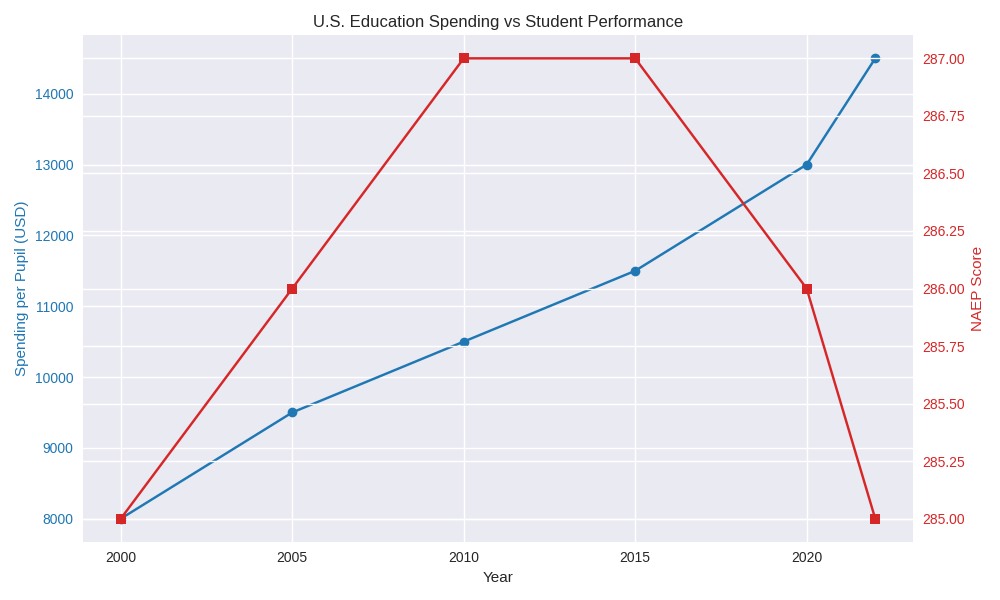
Despite record-high per-pupil spending, U.S. student performance has remained flat or declined on national assessments like the NAEP. In fact, high-spending states like New York and D.C. often underperform compared to lower-spending states like Utah and Idaho (Clarey, 2024). This chart illustrates the growing gap between spending and outcomes, a clear sign of systemic misalignment.
To restore legitimacy in public education, we must refocus unions on teacher representation, not political lobbying; demand transparency in bond spending; prioritize academic fundamentals over architectural optics; and empower teachers to shape curriculum and resource allocation. Until then, slogans like “for the children”, “for the teachers”, etc., will remain rhetorical shields for a system optimized for optics, not outcomes.
Public education has become less about learning and more about spending tax dollars through construction pipelines and vendor contracts. Bond-funded projects routinely enrich architectural firms, construction companies, and administrations, while the core mission of education erodes.
Gleaming facilities stand as monuments to institutional vanity, yet students who wish to stay after school to read, study, or explore ideas are often turned away. Libraries, once the heart of intellectual curiosity, sit dark and unused, shuttered under the excuse that “some parents might treat them as babysitters.” This rationale is paltry and paternalistic. It reflects a system more concerned with optics and liability than with cultivating minds.
I postulate that every school library should remain open for at least one hour after the end of the school day, providing students with a quiet, supervised space to read, study, and explore ideas.
If students fail to respect the space through disruption, misuse, or disregard for staff, they should face temporary loss of access as a natural consequence of violating a shared opportunity. The shuttered excuse punishes all for the hypothetical actions of a few, while the library, often the most intellectually potent space in the building, sits dark and unused, yet we paid for it.
As industries profit and administrations expand, the children fall further behind and teachers get pushed aside, not for lack of money, but for greed and optics. Meanwhile, these expansive and expensive facilities largely sit idle.
“They’ve lost much of the wonder, and gained very little skepticism.” — Carl Sagan
What we call education today is increasingly a performance, an empire of optics built on bond and tax-funded architecture, emotionally charged campaigns, and administrative expansion. School districts spend more and more, while delivering less and less of what truly matters. The curriculum is bloated with ideological messaging, while the core disciplines such as logic, thought, science, mathematics, and critical reasoning are left to flutter in the draft created by money burning holes in the pockets of district leadership.
It’s not just mismanagement. It’s a slow erosion of purpose. Real education teaches students how to think, not what to think. And until we restore that foundation, no amount of spending will close the gap between the gleam of our facilities and the dimming of our children’s futures.
References:
Clarey, B. (2024, December 23). Funding vs. performance: A closer look at education spending. Dallas Express. https://dallasexpress.com/education/funding-vs-performance-a-closer-look-at-education-spending/
DiSalvo, D. (2023). How teachers unions became a political powerhouse: A nuanced look at the role of unions in education policy. Education Next, 23(2), 69–70. https://www.educationnext.org/how-teachers-unions-became-a-political-powerhouse/
Kraus-Anderson. (2023, April). Five proven strategies for successful bond referendum campaigns. https://www.krausanderson.com/blog/five-proven-strategies-for-successful-bond-referendum-campaigns/
Hartney, M. T. (2022). How policies make interest groups: Governments, unions, and American education. University of Chicago Press.
.
 Missouri dBA